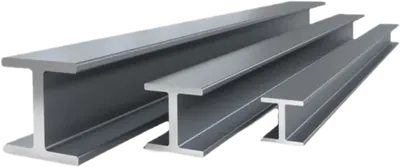
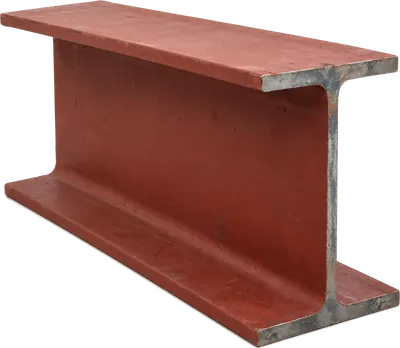
Short answer. All three are I-shaped steel beams. A true I-beam (American Standard "S" shape) has narrow flanges whose inner faces slope. A wide flange ("W" shape) has wider flanges with parallel faces, and it is the usual beam in modern steel buildings. An H-beam is a wide flange whose flange width is about equal to its depth, which makes it good for columns. Sizes are read as depth × weight (W8 × 31 = about 8 in deep, 31 lb/ft) or as depth × width × web × flange in mm (H 200 × 200 × 8 × 12).
The three shapes side by side
| I-beam (S shape) | Wide flange (W shape) | H-beam | |
|---|---|---|---|
| Flanges | Narrow, inner faces sloped | Wider, inner and outer faces parallel | As wide as (or nearly as wide as) the beam is deep |
| Looks like | A tall, slim "I" | An "I" with broad flanges | A square-ish "H" |
| Written as | S6 × 12.5 | W8 × 31 | H 200 × 200 × 8 × 12 (mm), or a W shape such as W8 × 31 |
| Standard | ASTM A6 (S shapes) | ASTM A6 (W shapes), steel usually A992 or A36 | JIS G3192 sizes, steel often SS400; or ASTM W shapes |
| Best at | Light beams, trolley and hoist runways, lintels | Floor and roof beams, girders, columns | Columns and heavy members loaded from more than one side |
| Connections | Sloped flange needs bevelled washers for bolts | Flat flanges: easy to bolt and weld | Flat flanges: easy to bolt and weld |
On site, "I-beam" is often used loosely for any of the three. When you order, use the designation from the drawing (S, W or H plus the size), not the nickname.
How to read a W (wide flange) size
A wide flange is written W depth × weight, both in inch-pound units under ASTM A6:
- W8 × 31: nominal depth 8 in, weight 31 lb per foot.
- The first number is a nominal depth: within one depth group, heavier beams are slightly deeper, so a W14 × 30 and a W14 × 43 are not exactly the same depth.
- The second number tells you the weight, and with it the size of the flanges and web.
To turn pounds per foot into kilograms per metre, multiply by 1.488:
| Shape | lb/ft | kg/m | Weight of a 6 m length |
|---|---|---|---|
| S6 × 12.5 (I-beam) | 12.5 | 18.6 | 111.6 kg |
| W6 × 15 | 15 | 22.3 | 133.9 kg |
| W12 × 26 | 26 | 38.7 | 232.2 kg |
| W8 × 31 | 31 | 46.1 | 276.8 kg |
| W10 × 33 | 33 | 49.1 | 294.7 kg |
| W14 × 43 | 43 | 64.0 | 384.0 kg |
Arithmetic only: 1 lb/ft = 1.488164 kg/m. The weight in the designation is the nominal weight; mill tolerances apply.
How to read an H-beam size
Asian mills, following JIS G3192, write H-beams in millimetres: H depth × flange width × web thickness × flange thickness. So H 200 × 200 × 8 × 12 is 200 mm deep, 200 mm wide, with an 8 mm web and 12 mm flanges.
You can estimate the weight from those four numbers. The plates of the "H" have an area of 2 × width × flange + (depth − 2 × flange) × web; multiply by 7,850 kg/m³:
| H-beam (mm) | Estimated kg/m (plates only) |
|---|---|
| H 100 × 100 × 6 × 8 | 16.5 |
| H 150 × 150 × 7 × 10 | 30.7 |
| H 200 × 200 × 8 × 12 | 48.7 |
| H 250 × 250 × 9 × 14 | 70.6 |
| H 300 × 300 × 10 × 15 | 91.8 |
Estimate only: rolled beams have rounded fillets where web meets flange, so the mill's published weight is a little higher (a few percent). Use the mill table or certificate for exact weight.
Which one should I use?
- Floor and roof beams, girders: wide flange, sized by the engineer. Its depth gives stiffness against sagging.
- Columns: H-beams or heavier, squarer W shapes, because their wide flanges resist buckling in both directions.
- Hoist and trolley runways, lintels, light beams: S-shape I-beams are common, and some hoist trolleys are made for the sloped flange. Check the trolley maker's beam list.
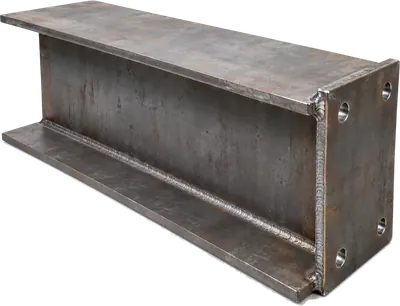
- Bigger than any rolled size: a built-up beam welded from plates, or a girder.
Never swap a W for an S of the same depth, or an H for a W, without the engineer's approval: the strength and stiffness are different even when the depth matches.
Common sizes buyers ask us for
Lines that come up on buyers' lists, usually in 6 m lengths and often cut to length with bolt holes drilled in the web or flange. Examples, not a limit:
- Wide flange: W6 × 20, W10 × 22, W10 × 30, W12 × 35, W14 × 43, W16 × 45, W16 × 50, W16 × 67, W18 × 71, W18 × 103, W18 × 119, W24 × 131, W27 × 146, and heavy shapes such as W14 × 211, W18 × 192 and W24 × 250
- I-beam: 18 in × 60 lb
- Channel: 127 × 48 × 8 mm; C purlins 155 × 55 × 20 × 2.5 mm and galvanized 250 × 50 × 2.5 mm
- Angle bar: 1-1/2 × 1-1/2 × 1/4 in, 3 × 3 in × 8 mm, 4 × 4 in × 6 mm
What to put in your RFQ
- Designation exactly as on the drawing: W8 × 31, S6 × 12.5 or H 200 × 200 × 8 × 12.
- Steel grade: A992, A36, SS400 or as specified, and whether you need a mill certificate.
- Length: full 6 m (20 ft) lengths, or cut lengths with a cutting list.
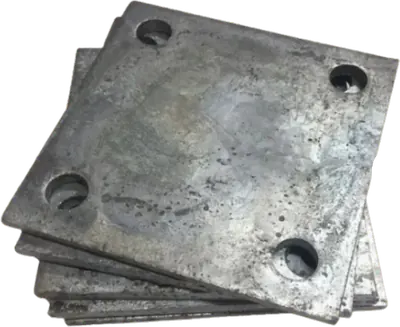
- Fabrication: holes, copes, end plates, stiffeners or welded base plates, with a drawing.
- Finish: plain, primed or hot-dip galvanized.
- Quantity, delivery city and target date.
Add an I-beam or wide flange to your RFQ and type the size. Not on our list? Send your size.