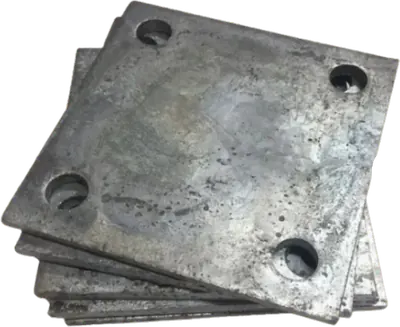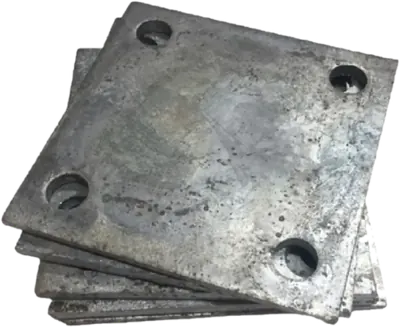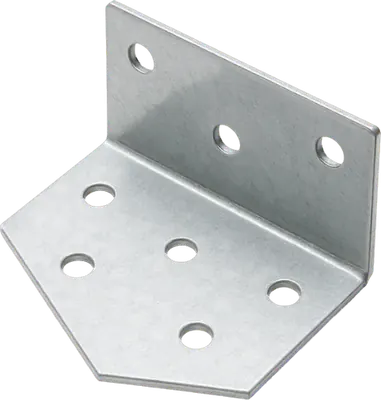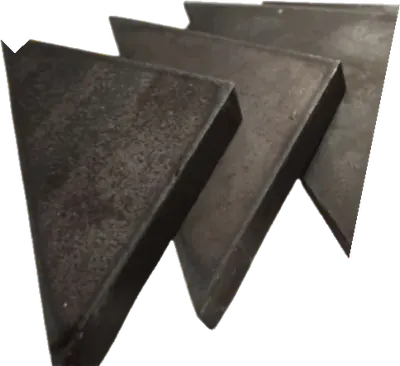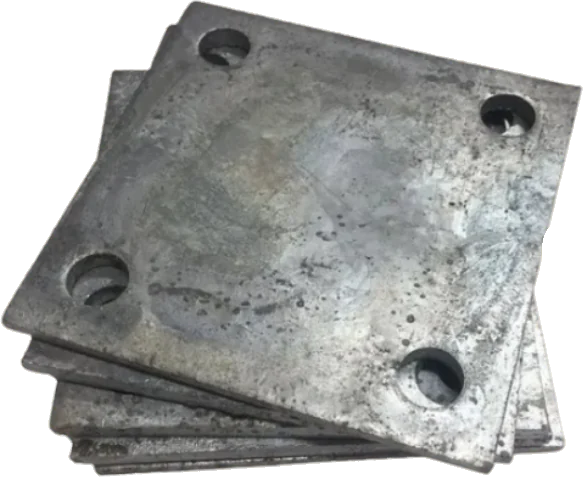
Short answer. A base plate is written thickness × width × length, for example 20 × 300 × 300 mm, with the number, size and spacing of the anchor holes. Its size and thickness come from the column load and the engineer's design, not from a standard list. Holes are drilled well oversize for the anchor rods (AISC allows up to a 1-5/16 in hole for a 3/4 in rod) and covered with a thick plate washer.
What sets base plate size and thickness
A base plate spreads the load of a steel column onto the concrete and gives the anchor rods something to hold. Three things drive its size:
- Bearing on concrete. The plate must be big enough that the concrete under it is not overstressed. Weaker concrete or heavier loads need a bigger plate.
- Bending of the plate. The part of the plate that sticks out beyond the column bends under the load. The further it sticks out, the thicker it has to be.
- Room for the anchors. The holes need clearance from the column, the welds and the plate edges, and room for a wrench on the nuts.
The method most engineers follow is AISC Design Guide 1, Base Plate and Anchor Rod Design. Because the result depends on the load, there is no single "standard" base plate: the drawing gives the size for each column type.
One rule applies to every steel building column: under OSHA 1926.755, a column must be anchored with at least four anchor rods so it stays stable while it is erected. Most drawings show four holes, one near each corner, or more for heavy columns.
Anchor hole and plate washer sizes
Holes in a base plate are made much larger than the anchor rod, so rods cast slightly out of position still fit. A plate washer then covers the big hole under the nut. The AISC Steel Construction Manual (Table 14-2, 15th edition) gives these recommended maximum hole sizes and minimum washer sizes:
| Anchor rod diameter | Hole diameter | Min. plate washer size | Min. plate washer thickness |
|---|---|---|---|
| 3/4 in | 1-5/16 in | 2 in | 1/4 in |
| 7/8 in | 1-9/16 in | 2-1/2 in | 5/16 in |
| 1 in | 1-13/16 in | 3 in | 3/8 in |
| 1-1/4 in | 2-1/16 in | 3 in | 1/2 in |
| 1-1/2 in | 2-5/16 in | 3-1/2 in | 1/2 in |
| 1-3/4 in | 2-3/4 in | 4 in | 5/8 in |
| 2 in | 3-1/4 in | 5 in | 3/4 in |
| 2-1/2 in | 3-3/4 in | 5-1/2 in | 7/8 in |
Source: AISC Steel Construction Manual, Table 14-2 (15th edition); older editions list slightly different sizes. Washers are usually square plate cut from the same steel. Your drawing may show different holes; the drawing governs.
Smaller holes, closer to the rod size, are used where the rods are set with a template and the engineer wants a tighter fit, for example for column bases that carry shear through the rods. Ask before changing hole sizes.
Plate material
Most base plates are cut from ASTM A36 plate (36 ksi or 250 MPa minimum yield, 58–80 ksi or 400–550 MPa tensile) or the Japanese JIS G3101 SS400. Both cut, drill and weld easily. Heavier designs may call for a higher grade such as ASTM A572 Grade 50; follow the drawing. For a list of plate thicknesses and weights, see the MS plate thickness chart.
How much a base plate weighs
Steel weighs about 7,850 kg per cubic metre, so a plate's weight is:
Weight (kg) = thickness (m) × width (m) × length (m) × 7,850, or in millimetres: t × W × L ÷ 1,000,000 × 7.85.
| Plate (t × W × L, mm) | Weight before holes |
|---|---|
| 16 × 250 × 250 | 7.85 kg |
| 20 × 300 × 300 | 14.13 kg |
| 25 × 400 × 400 | 31.40 kg |
Arithmetic only, at 7,850 kg/m³. Holes make the finished plate slightly lighter.
Common sizes buyers ask us for
Base plates are among the items we cut most often. These are the sizes that come up again and again on buyers' lists; they are a guide to what is usual, not a menu. Any size on your drawing can be cut.
| What | Sizes we regularly cut and supply |
|---|---|
| Thickness | 6, 8, 10, 12, 16, 19 to 20 and 25 mm (about 1/4, 5/16, 3/8, 1/2, 5/8, 3/4 and 1 in) for most orders; 4 to 5 mm for light brackets and 28 to 60 mm for heavy bases |
| Square plates | 200 × 200, 400 × 400, 250 × 250, 300 × 300, 150 × 150, 600 × 600, 350 × 350 and 100 × 100 mm |
| Rectangular plates | 200 × 250, 200 × 300, 250 × 400, 150 × 250, 400 × 800 and 400 × 1,000 mm, plus long strips for brackets and splices |
| Inch plans | 6 × 6, 6 × 8, 8 × 8, 12 × 18, 24 × 24 and 30 × 30 in |
| Holes | 4 holes is the most common; also 6, 8, 10 and 12 holes, or no holes. Hole diameters of about 10 to 24 mm on light plates |
| Finish | Plain for most orders; hot-dip galvanized or electro-galvanized when asked |
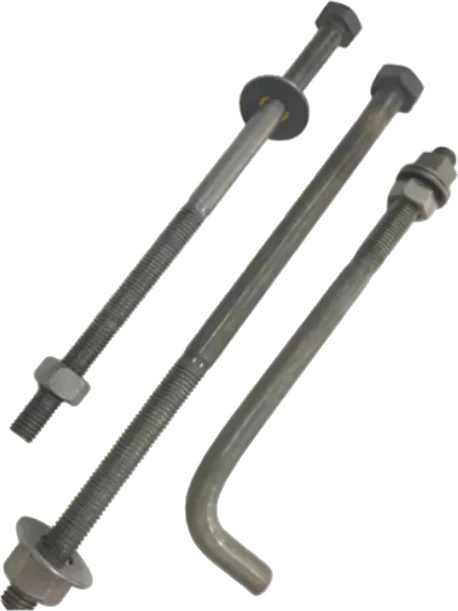
Base plates are often ordered as a set with their anchor bolts, for example four J-type anchor bolts per plate with two nuts and a washer each. Put both on one RFQ so the holes and the bolts match.
Cutting, drilling and finishing
A base plate order is a small fabrication job. The usual steps are cutting to size, drilling or punching the holes, cleaning the edges and, where needed, a finish:
- Holes are drilled or punched to the drawing; see plate holing and punching.
- Finish: plain (to be painted on site), primed, or hot-dip galvanized for outdoor work. If the plate and anchors are both galvanized, order galvanized nuts too.
- Grout holes in the middle of large plates let grout flow under the plate; add them if the drawing shows them.
Need the anchor bolts as well? See anchor bolt sizes to work out their length through the plate and grout.
What to send for a base plate quote
- Size: thickness × width × length, in mm (say if your drawing is in inches).
- Material: A36, SS400 or the grade on the drawing.
- Holes: how many, their diameter and their spacing from centre to centre and from the edges. A photo or PDF of the drawing is best.
- Plate washers, if needed: size, thickness and hole.
- Finish: plain, primed or hot-dip galvanized.
- Quantity per plate type, delivery city and target date.
Example line (format only): Base plate, A36, 20 × 300 × 300 mm, 4 holes Ø 33 mm at 200 mm centres, plain, 24 pcs, deliver to Laguna.
Add a base plate or foundation plate to your RFQ and attach the drawing. Not on our list? Send your size.